
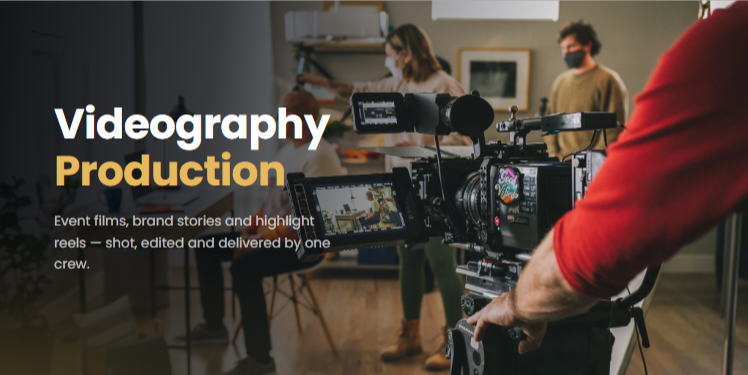
Videography production is the discipline of planning, filming, editing, and delivering video with a small, fast crew, and it is what most commercial work actually needs rather than a full film unit. A typical videography production job runs 2 to 8 weeks of preparation, 1 to 3 filming days, and two to eight weeks of editing. The quality of the result is decided before the camera arrives, in the week when the script, shot list, locations, and approvals either exist or do not.
This guide covers what videography production includes, the stages it moves through, what it costs and why, how it differs from cinematography, and how to judge a supplier before you sign.
What is videography production?
Videography production covers the whole path from brief to delivered files: concept, script, casting, locations and permits, the shoot, editing, colour, sound, graphics, and every cut and aspect ratio your channels need. The defining feature is scale. Videography production runs lean, adapts on the day, and is built for volume and speed rather than for a designed cinematic look.
That makes it the right model for most commercial content: interviews, testimonials, product demonstrations, site footage, conference coverage, and social series. The value comes from responsiveness and cost per finished asset, not from a lighting design that took three days to build.
The scope clients underestimate is the delivery list. One videography production day should not yield one video. It should yield a two minute anchor film, four vertical cuts, a paid ad version, stills pulled from the footage, and B-roll you reuse for a year. That list has to be agreed before filming, because vertical framing and extra coverage are shot decisions, not edit decisions. Our visual production team fixes the delivery spec at the brief stage for that reason.
Have a project in mind? Let us light it.
A specialist replies within minutes.
What is the video production process, stage by stage?
The video production process runs through five stages: planning and development, pre-production, production, post-production, and distribution. Videography production compresses these rather than skipping them, which is what makes it faster without making it sloppy.
Planning and development settles what the video is for, who watches it, and what they do next. Style gets decided here too, scripted or interview led, polished or deliberately raw. A brief that cannot name its audience produces a video that pleases the marketing team and nobody outside it.
Pre-production is the build: script and storyboard, shot list, casting, locations and permits, crew, equipment, schedule, and a locked budget. Almost everything that goes wrong on a filming day was decided, or left undecided, here. When a supplier offers to skip storyboarding to save a week, that week returns multiplied in the edit.
Production is the shoot, and it is the most expensive hour of the project because the whole crew is on the clock. Good crews are ruthless about the schedule and generous about coverage. Filming with the final aspect ratios in mind, and capturing more B-roll than feels necessary, keeps the edit flexible three months later when marketing asks for a version nobody planned.
Post-production is editing, colour, sound, motion graphics, subtitles, and versioning. Budget two or three feedback rounds and no more. The most common cause of a late delivery is not a technical problem, it is a review cycle with no named approver. Distribution closes the loop with platform specs, captions, thumbnails, and a paid plan. A film nobody sees is still a spent budget, which is why our digital marketing team joins before the final export rather than after it.
How long does videography production take?
Most videography production projects take one to two months from brief to delivery. Preparation takes 2 to 8 weeks depending on scripting, casting, and permits. Corporate shoots take 1 to 3 days. Longer form work such as documentary can run 2 to 4 weeks of filming. Editing takes about two weeks for straightforward pieces and up to two months when animation and multi-language subtitling are involved.
Three things stretch a schedule. Approvals sitting with a committee instead of a person add weeks, so name one approver before kickoff. Permits for public, government, or mall locations must start the day the location is chosen. And motion graphics is not a post-production task you bolt on midway, it is a parallel track with its own schedule.
For a fixed date such as a launch or an exhibition, work backwards from the date and add a two week buffer. Live events have no flexibility at all, and a film delivered the day after the conference is worth a fraction of the same film delivered the week before. When we produce content around event planning projects, the videography production schedule is built from the event date backwards.
Have a project in mind? Let us light it.
A specialist replies within minutes.
Videography vs cinematography: which one does your project need?
The videography vs cinematography question is really a question about planning and crew size. Videography captures what happens with one or two people and light preparation. Cinematography designs what happens, with a director of photography leading camera operators, gaffers, grips, and assistants, and with the look built before anyone walks on set.
A videographer works fast, adapts on the day, and handles events, interviews, and any situation where the moment cannot be repeated. A cinematographer, also called the director of photography, owns the visual language: lens selection, lighting design, camera movement, and the colour grade. That role starts in pre-production and stays through post.
Neither is superior. They answer different briefs. A conference recap, a founder interview, and a factory walkthrough all want videography production, because responsiveness and cost per asset are what matter. A brand film that will carry a paid campaign for a year wants cinematography, because the look has to survive comparison with everything else in the feed and cannot be repaired afterwards.
The mismatch costs money in both directions. Paying videography rates and expecting a cinematic result ends in disappointment, and booking a full lighting unit for something that needed one operator and a good microphone burns budget you could have spent on three more videos. A useful test: if the shot list can be written in advance and the lighting built, the project is cinematography. If the day is unpredictable, it is videography.
Should videography and photography be booked on the same shoot?
Yes, and with a dedicated photographer rather than a promise of frame grabs. Videography and photography share the location, the talent, and the schedule, so combining them saves real money. They diverge on lighting and on time per setup, which is why photography treated as a free extra almost always produces weak stills.
Video lighting is continuous and built for movement. Stills work often wants flash and a different exposure balance, and a photographer needs the subject to hold positions that an interview does not require. When one person covers both with one setup, something gives, and it is normally the photography.
The arrangement that works is one shoot day, one crew, a stills photographer alongside the video team, and agreed windows. Block ten minutes for portraits between interview setups instead of hoping to catch them. Frame grabs pass for social and fail for print, out of home, and anything needing heavy cropping.
Event coverage is where the two combine most naturally. A single team at an exhibition or conference can deliver a highlight film, vertical clips, and a full stills gallery from the same day, which is how our exhibitions and conferences management projects are usually covered.
Have a project in mind? Let us light it.
A specialist replies within minutes.
What are the video production examples worth commissioning first?
The video production examples that repay their budget most reliably are the customer testimonial, the product explainer, the brand film, the recruitment film, and the event recap. Most companies should build them in roughly that order rather than starting with the expensive one.
Testimonials are the cheapest high performing format in almost every category, and they are usually made badly. The fix is to stop scripting the customer. Interview them properly, ask questions that invite specifics, and cut around the answers. One testimonial that names a number outperforms ten that say the team was lovely.
Product explainers are measured on whether they reduce the questions your sales team fields. Product demonstration pages with video convert at around 4.8% against 2.9% without, a lift of roughly 65%, and explainer videos have been reported to raise conversions by as much as 80%. Screen recording or animation often beats a shoot here, because clarity matters more than beauty.
The brand film answers who you are in 60 to 120 seconds and sits on the homepage and at the top of paid campaigns. It has the longest shelf life and is the one piece genuinely worth cinematography rather than videography production.
Recruitment films have grown quickly because candidates research employers on video before applying, and the rule there is to film real employees at real desks. Event recaps are the workhorse: cut a 60 second version within 24 hours while people are still talking, then a longer film a week later. The fast cut normally outperforms the polished one.
What makes a videography video actually perform?
A videography video performs when it is cut for the platform it runs on, opens in under two seconds, and is short enough to hold attention. Videos under about 90 seconds retain roughly half their viewers, and 49% of marketers rank short form as their highest return format. Length is the easiest variable to get wrong and the cheapest to fix.
Engagement varies enormously by platform, so the same asset should not be published identically everywhere. TikTok runs at around 2.80% engagement, Instagram Reels at roughly 0.65%, and YouTube Shorts between 0.30% and 0.40%. The vertical cut you make for TikTok deserves a different opening frame and caption from the one you upload to Shorts.
Video works commercially at scale: 89% of businesses use it and 93% of marketers report good returns. That also means the baseline has risen, so competent filming is no longer a differentiator and the gap now comes from consistency and distribution. Pair the output with a documented brand guidelines system so titles, colour, and typography stay identical across every cut, and plan the posting through social media accounts management rather than uploading and hoping.
Have a project in mind? Let us light it.
A specialist replies within minutes.
What does videography production cost, and what drives the number?
Cost follows shoot days first, crew size second, and post-production complexity third. Location and talent matter, but neither moves a budget the way a second filming day or a heavy animation sequence does.
Crew size is the largest multiplier. A one person setup, a three or four person crew, and a full cinematography unit with a director of photography, gaffer, grip, and assistants sit at very different price points, and the gap widens with every day. Defining the format honestly at the brief stage saves far more than negotiating day rates later.
Post-production is where budgets quietly expand. Colour grading, sound mixing, motion graphics, Arabic and English subtitles, and versioning for four platforms each consume real hours. Fix the revision rounds in the contract, because unlimited revisions is not generosity, it is a schedule with no end date.
The most effective way to lower cost per video is to raise output per shoot day. Two well planned days that produce fifteen usable assets cost far less per asset than five scattered half days that produce eight. Commission a quarter of content in one go rather than one video at a time.
How do you choose a video production company?
Choose a video production company on relevant finished work, named crew, and a written delivery list, not on the camera bodies they own. Anyone can rent the same equipment. What differs is whether they have made your kind of film before and who exactly will be standing on set.
Ask to watch two or three complete projects in your category rather than a showreel. Reels show the best three seconds of everything; a finished two minute corporate film reveals whether a team can hold a structure, pace an interview, and land a message.
Ask who directs and who operates the camera, by name, and whether they are staff or booked freelancers. Freelance crews are normal and often excellent, but you should know before the shoot rather than on the morning.
Get the delivery list in writing: formats, aspect ratios, durations, subtitle files, revision rounds, and ownership of the raw footage. Footage ownership is the clause clients forget and regret. If you do not own the rushes, you cannot recut the film next year without going back to the same supplier on their terms.
Finally, ask how they handle permits. Filming in public spaces, malls, government facilities, and many private venues in Saudi Arabia needs prior approval, and a supplier who treats that casually will cost you a shoot day.
Have a project in mind? Let us light it.
A specialist replies within minutes.
Is a video production near me search worth acting on?
Searching for a “video production near me” is worth acting on when you need scouting, permits, and crew logistics, and it matters much less for editing, colour, and animation, which travel perfectly well over the internet.
What a local supplier buys you is a better preparation week. Scouting in person, understanding the light at the hour you intend to film, and knowing which venues approve permits quickly are all local knowledge, and travel costs disappear.
The counterargument is specialisation. If a project needs high end 3D animation or underwater work, hire the specialist wherever they are. A local crew paired with a specialist for post works well, provided one party owns the schedule. Our guide on choosing a marketing agency near you applies the same reasoning to agency selection.
What is changing in Saudi videography production in 2026?
Saudi Arabia raised its film and television production rebate to a headline rate of 60% in May 2026, up from a 40% base, administered by the Saudi Film Commission with the Cultural Development Fund and with faster disbursement attached. That has pulled international productions into the Kingdom and deepened the local pool of crew, equipment, and post facilities.
The effect on commercial work is indirect but real. Crews that move between international features and commercial jobs raise the standard of a corporate shoot, and rental options widen. Availability tightens too, so booking a preferred director of photography four to six weeks ahead is now normal rather than cautious.
The audience side has shifted too. Saudi Arabia has 34.4 million internet users at 99% penetration, YouTube reaches the equivalent of 79.2% of the population with 27.5 million users, and Snapchat sits at 72.9%, according to DataReportal’s Digital 2026 report. Almost everyone you want to reach is watching video daily on a phone held vertically.
That is why briefs in the Kingdom now start vertical, with the horizontal cut treated as the secondary deliverable. If your supplier still films landscape and crops afterwards, your social output will look worse than your competitors’ for reasons that have nothing to do with budget.
Have a project in mind? Let us light it.
A specialist replies within minutes.
Why work with Serajj for videography production?
Serajj handles videography production for Saudi and Gulf clients with the marketing team attached rather than subcontracted. Our visual production service covers concept, script, crew, filming, and post, and the same brief carries through to creative content and influencer marketing so the film has somewhere to go on the day it is delivered.
You can look through our work, read about the team on our about page, or tell us what you need to film and we will tell you honestly whether it needs a crew of one or a crew of eight.
Key takeaways
- Videography production means a lean crew, fast turnaround, and volume. Cinematography means a designed look and a full unit. Match the model to the brief before comparing prices.
- The video production process has five stages, and preparation decides the outcome: 2 to 8 weeks of it, with 1 to 3 filming days and two to eight weeks of editing.
- One shoot day should produce many assets. Agree the delivery list, vertical cuts included, before the camera is set up.
- Photography deserves its own budget line. Frame grabs work for social and fail for print.
- Keep videos under about 90 seconds, and cut separately for TikTok, Reels, and Shorts because their engagement rates differ by a factor of several.
- Saudi Arabia’s production rebate reached a 60% headline rate in May 2026, deepening the local crew pool and making early booking sensible.
Have a project in mind? Let us light it.
A specialist replies within minutes.
Frequently asked questions
What is videography production?
Planning, filming, editing, and delivering video with a small crew and a fast schedule. It covers concept, script, locations and permits, the shoot, post-production, and every cut each platform needs.
What is the video production process?
Five stages: planning and development, pre-production, production, post-production, and distribution. Pre-production decides most of the final quality because script, shot list, locations, and approvals are all settled there.
How long does videography production take?
One to two months for most commercial projects: 2 to 8 weeks of preparation, 1 to 3 days of corporate filming (2 to 4 weeks for longer form), and two weeks to two months of editing.
What is the difference in videography vs cinematography?
Videography uses one or two people and light planning to capture events and interviews. Cinematography uses a director of photography and a full crew to build a designed look, planned in pre-production and finished with a colour grade.
Should videography and photography be shot on the same day?
Yes for events and most commercial shoots, but book a dedicated photographer instead of relying on frame grabs. Video and stills want different lighting, so block separate windows for portraits.
What are good video production examples to start with?
Customer testimonials, a product explainer, a brand film, a recruitment film, and event recaps. Testimonials usually deliver the strongest return relative to cost.
How do I choose a video production company?
Watch two or three finished projects in your category rather than a showreel, get the director and camera operator named, and put the delivery list, revision rounds, and footage ownership in the contract.