
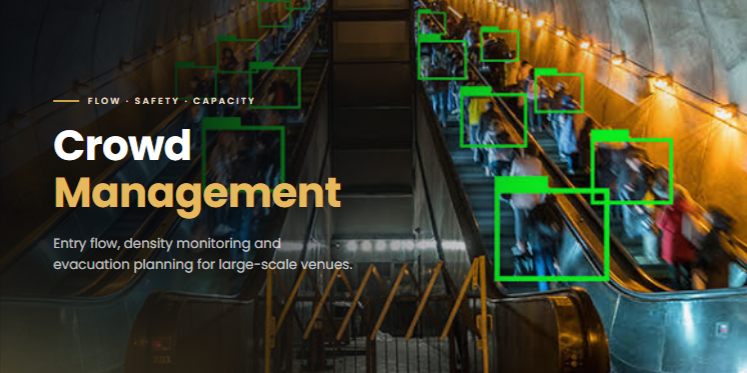
Crowd management is the planning, monitoring and guiding of people so an event stays safe, legal and comfortable at every moment from the first arrival to the last exit. It is proactive work done months before the doors open. Crowd control is the reactive half that starts only when a crowd behaves in a way the plan did not intend, and an event that relies on it has already lost.
The distinction decides how you spend money. Teams that invest early buy layout studies, density modelling, signage and trained staff. Teams that skip it buy barriers and extra guards on the day, which is the most expensive and least effective moment to buy anything.
Saudi Arabia runs the largest crowd operation on earth every year. GASTAT recorded 1,707,301 pilgrims for Hajj 1447 AH in 2026, up from 1,673,230 the year before, and Riyadh Season passed 8 million visitors within months of its October launch according to the General Entertainment Authority. Events here are planned against that benchmark, which is why the Saudi standard for crowd management in events is higher than most organisers expect on their first project.
Have a project in mind? Let us light it.
A specialist replies within minutes.
What is the difference between crowd management and crowd control?
Crowd management is proactive and continuous. Crowd control is reactive and specific. Every serious plan contains both, and the phrase crowd control and management describes the pair working together rather than two competing disciplines.
Think of it as a ratio. On a well-run event, roughly 90% of the effort is crowd management: capacity calculations, entry scheduling, queue design, wayfinding, staff briefings and live density monitoring. The remaining 10% is crowd control management, the interventions you keep in reserve when a queue overloads, a performer appears early or an exit is blocked. When that ratio inverts, you are no longer managing a crowd. You are chasing one.
Managing crowd behaviour is mostly about removing the reasons a crowd behaves badly. People push when they cannot see, cannot hear and do not know how long they will wait. Fix the sightlines, the announcements and the queue information and most of the pushing disappears before anyone has to intervene.
What are the four stages of crowd management?
The four stages of crowd management follow the four phases of the event itself: planning, pre-production, production and post-production. Practitioners also describe them as assess, prepare, operate and review, which maps onto the same sequence.
- Planning. Choose a venue that can physically hold the audience you intend to sell to. Calculate capacity from usable floor area rather than the venue’s headline number, model the arrival and departure curves, and identify the pinch points where flows cross. Most crowd failures are decided here, months before anyone arrives.
- Pre-production. Turn the plan into documents and hardware. The crowd management plan, the emergency response plan, the risk assessment, the staffing schedule, the signage and barrier layout, the radio channel plan, and the briefing that every steward will receive. This is also when licensing and safety approvals are filed.
- Production. The live stage, from load-in to load-out. Counting people in and out, watching density in real time, holding or releasing queues, running the control room, and making the small early interventions that prevent large late ones. This is when most incidents occur, because it is the only stage where the plan meets actual human beings.
- Post-production. Incident logs, near-miss reports, counted attendance against forecast, staff debriefs and a written set of changes for the next edition. Skipping this stage is why the same event repeats the same queue failure for three years running.
Have a project in mind? Let us light it.
A specialist replies within minutes.
What are the three main methods of crowd control?
The three main methods of crowd control are physical, human and informational: barriers and layout, trained personnel, and communication.
- Physical. Barriers, fencing, mojo barriers at stage fronts, turnstiles, lane dividers, one-way routes and the geometry of the space itself. Physical measures work without anyone having to say a word, which makes them the most reliable and the least flexible. A badly placed barrier creates the crush it was meant to prevent.
- Human. Stewards, crowd safety officers, ushers, medical teams and a control room with a single named commander. People adapt where barriers cannot, but only if they are briefed on the specific plan for that specific venue. Generic security staffing is not crowd management, and Saudi regulators say so explicitly: untrained security personnel do not satisfy crowd management requirements.
- Informational. Signage, screens, announcements, app notifications, staff scripts and queue-time displays. Information is the cheapest intervention available and the most underused. A crowd told “the next entry wave opens in six minutes” behaves completely differently from a crowd told nothing.
The National Safety Council frames the same logic as a hierarchy: eliminate the hazard where you can, guard or enclose it where you cannot, and train people to handle what remains. Applied to crowd control and management, that means redesigning the pinch point first, barriering it second, and staffing it third.
What goes into a crowd management plan?
A crowd management plan is the document that turns intent into instructions. In Saudi Arabia it is not optional: the General Entertainment Authority requires one for licensed entertainment events and conducts pre-event site visits, with the power to halt an event that does not comply.
A usable plan covers eight things:
- Capacity. The number the venue can safely hold, calculated from usable area, with the method shown rather than asserted.
- Entry and exit flow. Arrival profile, gate count, throughput per gate per minute, and the departure surge that follows the final act.
- Density monitoring. Who watches which zone, with what tool, and the specific number that triggers action.
- Staffing. Positions, ratios, shift pattern, briefing content and the reporting line to the control room.
- Communication. Radio channels, call signs, public address scripts, screen messaging and the single person authorised to make announcements.
- Emergency procedures. Evacuation and invacuation routes, assembly points, medical provision and the trigger words that start each procedure.
- Vulnerable groups. Accessible routes, family areas, children, elderly attendees and anyone who cannot move at crowd speed.
- Escalation. What happens at each stage, who decides, and at what point the event stops.
Write it so a steward can act on it, not so a regulator can file it. The best test is simple: hand the plan to someone who has never seen the venue and ask them what they would do if the north gate queue doubled in ten minutes. If the plan does not answer, it is not finished.
Alongside it sits the emergency response plan, the risk assessment and, for temporary structures, engineering certification. Some organisers merge the first two into a single crowd control management plan, which works as long as nothing gets lost in the merge.
Have a project in mind? Let us light it.
A specialist replies within minutes.
What is a crowd management system and how does it work?
A crowd management system is the combination of counting, monitoring and communication technology that tells the control room what a crowd is doing right now, rather than what it did an hour ago.
A working system has four layers. Counting at the perimeter through turnstiles, ticket scans or computer vision, so occupancy is known rather than estimated. Monitoring inside the site through CCTV analytics, LiDAR sensors, overhead cameras or mobile network heat maps, converting camera feeds into a density figure per zone. Alerting, where the system flags a zone crossing its threshold before a human notices. And response, where the control room can change signage, hold a gate, reroute a flow or push a notification within seconds of the alert.
Saudi Arabia operates this at national scale. For Hajj 1447 AH, the Ministry of Interior ran artificial intelligence and predictive analytics through advanced command and control centres, explicitly to anticipate congestion before it formed rather than respond to it after. That is the entire philosophy of modern crowd management systems compressed into one sentence: predict, then prevent.
For a commercial event, the same principle scales down. A 3,000-guest conference does not need predictive AI. It needs accurate entry counts, three cameras on the two pinch points, a threshold everyone has agreed, and a person whose only job is watching them. Most crowd management solutions sold as technology fail for one reason: nobody is assigned to look at the screen.
What is a safe crowd density?
Crowd density is measured in people per square metre of usable space, and it is the single number that separates a busy event from a dangerous one.
UK event guidance sets 2 people per square metre as the working safety limit for general event areas. The Green Guide allows 4.7 people per square metre for standing viewing areas at sports grounds. Professor G. Keith Still, whose crowd science underpins most modern practice, states that 5 people per square metre should be the upper limit for standing and viewing spaces, and warns that published figures fail to account for demographics, since the physical size of the people in the crowd changes what any given density actually means.
Two practical consequences follow. First, average density across a site is meaningless; crowds are never evenly distributed, and the incident always happens in the one zone that hit 5 while the site average read 1.8. Measure by zone. Second, density and flow interact: a crowd at 4 people per square metre that is still moving is far safer than the same density brought to a standstill by a blocked exit. Watch both numbers, not one.
Have a project in mind? Let us light it.
A specialist replies within minutes.
How does crowd and crisis management differ from normal operations?
Crowd and crisis management is the part of the plan that assumes something has already gone wrong. Normal operation keeps a crowd comfortable; crowd crisis management keeps it alive when a stage collapses, a fire alarm sounds, weather turns or an evacuation becomes necessary mid-performance.
The difference is command, not tactics. In normal operation, decisions are distributed: gate leads manage their own queues. In a crisis, decision-making collapses to one person in the control room, and everyone else executes. Events that have not rehearsed that handover lose several minutes discovering who is in charge, and several minutes is the entire budget.
Three things make crowd crisis management work. A written trigger list, so nobody debates whether the situation qualifies. A rehearsed communication cascade, so the message reaches 200 staff in under a minute. And a pre-agreed relationship with Civil Defense, the Red Crescent and venue security, so external responders arrive into a structure instead of into confusion.
Who regulates crowd management in events in Saudi Arabia?
Several authorities share the file, and which one leads depends on your event format.
The General Entertainment Authority (GEA) licenses ticketed entertainment — concerts, festivals, comedy, gaming — and requires venue certification, a crowd management plan and emergency response protocols. It runs pre-event site visits and can stop an event that fails them.
Civil Defense holds fire safety and emergency planning across every event type, with standards aligned to NFPA codes, covering suppression systems, exits, evacuation plans and safety personnel. Pyrotechnics and special effects carry their own permit with a six to eight week lead time, so they are a planning item and not a late addition.
The Saudi Conventions and Exhibitions General Authority (SCEGA) licenses trade exhibitions, conferences and corporate conventions. The National Events Center operates the Enjaz platform for event applications and Matloob for connecting organisers with approved suppliers. Cultural formats involve the Ministry of Culture, sporting formats the Ministry of Sports.
The practical lesson for any crowd management company working here: the approval route is decided by format, and it changes the design. Confirm it in week one, because the answer can change your venue, your capacity and your promotion date.
Have a project in mind? Let us light it.
A specialist replies within minutes.
What training is needed for crowd management?
Training runs on three levels, and events need all three present.
- Stewards need role-specific training in crowd safety, not general security training. The recognised international benchmark is the Level 2 Certificate in Spectator Safety, awarded by bodies including NCFE and Highfield, which covers crowd dynamics, entry and exit control, emergency procedures and customer care. Saudi regulators make the same point in plainer language: untrained security personnel do not meet the requirement.
- Supervisors and crowd safety officers need training in crowd science itself, including density interpretation, flow modelling and risk analysis, plus practical experience of the specific venue type they are working.
- The event’s leadership needs incident command training, because the failure mode at senior level is hesitation rather than ignorance. Tabletop exercises before the event are worth more than any certificate on the day.
Add to all of it the briefing that is specific to your event: this venue, this audience, these gates, these triggers, this radio channel. A certified steward who has not been briefed on your site is a generic steward.
How do you choose a crowd management company?
Ask five questions of anyone offering crowd management solutions, and judge them on how specific the answers get.
- Show me a crowd management plan you wrote. Not a template. A real one, with real capacity calculations and real trigger numbers.
- How do you calculate capacity? If the answer is the venue’s published number, keep looking. Usable area is what matters.
- What is your density threshold and who watches it? A named role and a named number, or the monitoring is decorative.
- Who commands in a crisis? One name. If there are two, there is none.
- What did you change after your last event? Teams that run a real post-production review will answer immediately. Teams that do not will improvise.
The gap between suppliers is rarely equipment. It is whether the crowd control event planning was done in week one or week eleven.
Have a project in mind? Let us light it.
A specialist replies within minutes.
How Serajj approaches crowd management
Serajj treats event crowd management as part of event design rather than something bolted on at the end. On our exhibitions, conferences, launches and ceremonies, the layout, the guest journey and the run sheet are drawn with density and flow in mind before the visual concept is signed off, because a stage position that ruins a sightline creates a pushing problem no amount of staffing fixes later.
Every project has one named producer who owns the crowd plan alongside the creative and the build, so the person deciding where the photo wall goes is the same person accountable for the queue it creates. We map the licensing and safety route in week one, coordinate the venue’s own approvals, and brief stewards on the specific site rather than handing them a generic pack.
We have delivered events for more than 150 clients across the public and private sectors, including the Ministry of Defense, the Ministry of Agriculture and the Museums Commission, where protocol, security coordination and documentation are routine rather than a first attempt. See how the wider service works on our event management page, or read our guide to choosing an event management company in Saudi Arabia.
The visual production and creative content teams work inside the same plan, which matters more than it sounds: camera positions, influencer meet-and-greets and photo moments are three of the most common causes of unplanned crowd density at commercial events. Planning them with the crowd plan instead of against it removes the problem at source.
Request a proposal and a producer will reply the same working day.
Key takeaways
- Crowd management is proactive planning and monitoring; crowd control is the reactive intervention you keep in reserve. Aim for a 90/10 split.
- The four stages of crowd management are planning, pre-production, production and post-production, and most failures are decided in the first one.
- The three methods of crowd control are physical, human and informational: barriers and layout, trained staff, and communication.
- A crowd management plan must state capacity, flow, density thresholds, staffing, communication, emergencies, vulnerable groups and escalation, in language a steward can act on.
- Safe density is measured by zone, not as a site average: 2 people per square metre is the working event limit, and 5 per square metre is the upper limit for standing spaces.
- In Saudi Arabia, GEA requires a crowd management plan for licensed entertainment events and can halt events that fail a site visit, while Civil Defense holds fire and emergency planning to NFPA-aligned standards.
- Technology only works when someone is assigned to watch it. Most systems fail for that reason alone.
Have a project in mind? Let us light it.
A specialist replies within minutes.
Frequently asked questions
What are the four stages of crowd management?
The four stages of crowd management are planning, pre-production, production and post-production, sometimes described as assess, prepare, operate and review. Planning covers venue selection and capacity calculation. Pre-production produces the crowd management plan, staffing and approvals. Production is the live event, from load-in to load-out, where most incidents occur. Post-production covers incident logs, debriefs and the documented changes for the next edition.
What is a crowd management system and how does it work?
A crowd management system combines counting, monitoring, alerting and response technology so the control room knows current occupancy and density rather than estimating it. Turnstiles or ticket scans count people in and out, CCTV analytics or LiDAR sensors convert camera feeds into a density figure per zone, the system alerts when a zone crosses its agreed threshold, and staff respond by holding a gate, rerouting a flow or changing messaging. For Hajj 1447 AH, Saudi Arabia’s Ministry of Interior ran AI and predictive analytics through command and control centres to anticipate congestion before it formed.
What are the three main methods of crowd control?
The three main methods of crowd control are physical, human and informational. Physical means barriers, turnstiles, lane dividers and the layout of the space. Human means trained stewards, crowd safety officers, medical teams and a control room with one named commander. Informational means signage, screens, announcements and queue-time messaging. Information is the cheapest of the three and the most frequently neglected.
What training is needed for crowd management?
Stewards need crowd-specific training rather than general security training, benchmarked internationally by the Level 2 Certificate in Spectator Safety from awarding bodies including NCFE and Highfield. Supervisors need crowd science training covering density, flow and risk analysis. Event leadership needs incident command training and rehearsed tabletop exercises. All of it must be topped with a site-specific briefing, because a certified steward who has not been briefed on your venue is a generic steward.
What is the difference between crowd management and crowd control?
Crowd management is the proactive discipline of planning, monitoring and guiding people throughout an event. Crowd control is the reactive set of interventions used when a crowd behaves outside the plan. Crowd management and control together form one system, and an event relying mainly on the control half has usually failed at the management half.
Who approves a crowd management plan in Saudi Arabia?
It depends on the format. The General Entertainment Authority licenses ticketed entertainment and requires a crowd management plan plus emergency response protocols, with pre-event site visits. Civil Defense approves fire safety and emergency planning to NFPA-aligned standards. SCEGA licenses exhibitions and conferences, and the National Events Center runs the Enjaz permit platform.
What is a safe crowd density at an event?
UK event guidance treats 2 people per square metre as the working safety limit for general event areas, the Green Guide allows 4.7 per square metre for standing viewing areas, and crowd scientist Professor G. Keith Still puts the upper limit for standing and viewing spaces at 5 per square metre. Measure density by zone rather than as a site average, and watch flow alongside density, because a dense crowd that stops moving is the dangerous one.
Do small events need crowd management?
Yes, in proportion. A 300-guest conference needs a capacity figure, an entry plan, a briefed team and an evacuation procedure. It does not need sensors or a control room. The scale of the plan should match the scale of the risk, but the absence of a plan is never proportionate.