
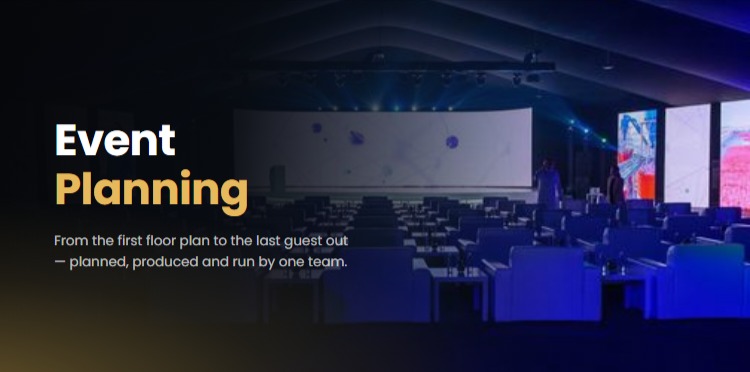
Event planning is the work of converting a business objective into a live experience: you define what the event must achieve, then design the budget, date, venue, programme, supplier chain, and marketing campaign that deliver it. A realistic planning cycle runs 12 to 16 weeks for a mid-size corporate event and 6 to 9 months for a conference, exhibition, or festival. Most events that disappoint were not badly imagined; they were started too late, and every compromise after that point was a consequence of the calendar rather than the concept.
This guide covers the full sequence, from the first objective statement to the post-event report, with the licensing rules, budget ratios, and lead times that apply in Saudi Arabia in 2026.
What is event planning, exactly?
Event planning is the design phase: objectives, audience, format, budget, venue, timeline, and supplier scope, all settled before anything is built. Event management is the execution layer that turns the plan into a delivered day, and event production is the technical build inside it. The three words get used interchangeably, but they describe different responsibilities and, in the Kingdom, different legal positions on a licence application.
The formats are wider than most people assume. A corporate conference, a trade exhibition, a product launch, an annual general meeting, a government forum, a sponsor activation, an awards gala, and a private wedding all use the same underlying process. What changes is the weighting: an exhibition lives or dies on floor plan and exhibitor sales, a launch on media attendance and content capture, a gala on guest experience and room design. Serajj sits on the business-events side of that spectrum, which is why our exhibitions and conferences management service and our marketing services run as one team.
Have a project in mind? Let us light it.
A specialist replies within minutes.
What are the seven stages of event planning?
Every well-run event moves through seven stages in order: objective, budget, date and venue, programme, suppliers, marketing, and delivery with reporting. Skipping a stage does not save time; it moves the cost to a worse moment:
- Stage one is the objective and its metric. Write one sentence saying what the event must produce and how you will know it did. “Generate 120 qualified leads from Saudi retail decision-makers” is an objective; “raise awareness” is not, because nothing downstream can be decided from it. Venue, run time, guest list, and content all flow from that sentence.
- Stage two is the budget and scope. Set the total before you fall in love with a venue. The number determines guest count far more than guest count determines the number, and a guest list that grows after the budget is fixed is the most common source of late-stage panic.
- Stage three is date, venue, and licensing. These are one decision rather than three, because the licence depends on the venue and the venue depends on the date. In Riyadh and Jeddah the October-to-March window is heavily contested, and the strongest ballrooms and exhibition halls are committed six to nine months out.
- Stage four is programme and content design. Decide the shape of the day: session lengths, speaker count, breaks, the moment the main message lands, and where the photography and video will come from. An agenda with nine speakers and no breaks produces an exhausted room and no usable content.
- Stage five is supplier contracting and production, covering catering, AV, staging, furniture, signage, security, medical, transport, insurance, and crew. Contract with cancellation terms that match your own exposure, and hold a technical site visit with the venue’s operations team before the drawings are final.
- Stage six is marketing and registration, which runs in parallel with production rather than after it. Registration pages, paid campaigns, influencer marketing, organic posts through social media accounts management, press outreach, and reminder sequences all go live weeks before the first guest arrives.
- Stage seven is delivery and the post-event report. The run of show governs the day; the report closes the loop within ten working days, while supplier data, registration exports, and attendee feedback are still fresh.
How far in advance should you start planning an event?
Start 6 to 8 weeks out for a small internal event, 12 to 16 weeks for a mid-size corporate event of 150 to 400 guests, 6 to 9 months for a conference or exhibition, and 9 to 12 months for a festival or an international summit. These are working minimums, not comfortable timelines.
The constraint that catches organisers by surprise is not the venue; it is the permit. Small business events generally need 2 to 4 weeks of licensing lead time, standard conferences and exhibitions 4 to 8 weeks, and large festivals, concerts, and international events 3 to 6 months, because those trigger approvals from multiple authorities in sequence rather than in parallel. If your date is eight weeks away and the venue is not yet contracted, the licence timeline is what decides whether the date holds.
Two other lead times deserve their own calendar entry. Custom exhibition stands and bespoke stage sets need 6 to 10 weeks from approved drawings to delivery, and travel arrangements for international speakers should start the moment a speaker confirms.
Have a project in mind? Let us light it.
A specialist replies within minutes.
What is the difference between an event planner, an event organizer, and an event manager?
An event planner designs the event, an event organizer owns and is legally accountable for it, and an event manager runs it on the day. In Saudi Arabia this distinction has practical weight, because the licence is issued to the organizer of record, and that entity carries the compliance obligation for the venue, the crowd, and the content.
In smaller projects one agency plays all three roles; in larger ones the client is the organizer, the agency is the planner and manager, and a production house handles the build. Problems appear when roles are assumed rather than assigned. Before contracting, write down who holds the licence, who signs supplier contracts, who can approve spend on site, and who makes the call if the schedule slips by forty minutes. Those four answers prevent most disputes that surface at 6pm on show day.
The related trap is the “event organizer” who is really a broker. A supplier who cannot name their own on-site crew or describe a licence application they have handled is reselling someone else’s capacity and adding margin without adding control.
How much does event planning cost, and how should the budget be split?
Venue and catering together typically consume 50 to 70 percent of total event spend, which leaves every other category competing for a much smaller pool than first-time organisers expect. Per-attendee costs vary widely by format, so budget per head against your own format rather than an industry average.
A workable starting frame for a Saudi corporate conference allocates roughly 20 to 25 percent to venue, 25 to 30 percent to food and beverage, 15 to 20 percent to production and AV, 8 to 12 percent to content and creative, 8 to 10 percent to marketing and registration, 5 to 8 percent to staffing, and 2 to 4 percent to permits and insurance. Treat that as a sanity check on your quotes, not a formula: if production sits at 5 percent for an event whose whole purpose is a televised keynote, the split is wrong whatever the benchmark says.
Contingency is the line most often cut and most often needed. Hold 10 to 15 percent of the total for an event you have run before and 15 to 20 percent for a first edition, where unknowns cluster around venue restrictions, licensing conditions, and last-minute guest count changes. Sponsorship, where the format supports it, commonly offsets 20 to 40 percent of total costs, but sponsorship revenue should be treated as confirmed only when the contract is signed, because a budget built on verbal commitments is a budget with a hole in it.
One line that repays itself is the content plan. An event lasts a day, while the visual production assets it generates run for a year across campaigns, website, and sales decks. Budgeting one photographer for a launch meant to produce a quarter of content is a false economy.
Have a project in mind? Let us light it.
A specialist replies within minutes.
What permits do you need for managing an event in Saudi Arabia?
Business events are licensed by the Saudi Conventions and Exhibitions General Authority (SCEGA), and entertainment events are licensed by the General Entertainment Authority (GEA). SCEGA covers conferences, exhibitions, trade shows, forums, and corporate conventions. GEA covers concerts, festivals, live shows, and family entertainment. Getting this classification right is the first step, because applying to the wrong authority costs you the full processing window.
Secondary approvals commonly involve the Ministry of Interior, the municipality, Civil Defense, and, depending on content, the Ministry of Culture or the Ministry of Sports. The practical sequence runs: classify the event and identify the authority, confirm legal standing through a commercial registration or a local partner, prepare venue, safety, and organizer documentation, submit through the authority’s portal, coordinate secondary approvals, pass inspection and settle fees, then operate within the approved scope.
The compliance layer is real rather than nominal. The General Entertainment Authority reported that licensed entertainment events and activities across the Kingdom drew more than 45 million visitors in the first half of 2026, with over 7,200 companies operating in the sector, more than 2,500 licences issued, and more than 8,500 inspection visits carried out in the same period, alongside 1,127 classification certificates and coordination with 29 government entities. An events market at that scale is an inspected market, and an organizer who treats the permit as paperwork rather than as an operating condition is exposed on show day.
If you want the fuller treatment of how agencies handle this on your behalf, our guide on how to choose an event management company in Saudi Arabia covers the evaluation criteria in detail.
How do you build a run of show that holds on the day?
A run of show is a minute-by-minute document listing every cue, the person responsible for it, and what happens if it slips. Build it as one shared file covering time, duration, cue, owner, and backup, and give a single named person authority to update it during the event.
Three habits keep it honest. Build roughly ten minutes of buffer into every programme hour, because registration, arrivals, prayer timings, and guest movement always run longer than planned. Rehearse the transitions rather than the content, since almost every visible failure happens between segments. Fix one communication channel in advance, because a fragmented comms plan turns a small delay into three conflicting instructions. And give the schedule to someone who is not also running a station, or it stops being held.
Have a project in mind? Let us light it.
A specialist replies within minutes.
What makes elegant events feel elegant rather than just expensive?
Elegant events are built on restraint and coherence, not on budget. The reliable markers are a single design language carried across invitation, signage, stage, print, and screen; lighting treated as a primary design element rather than an afterthought; and a guest journey with no visible friction from car park to seat.
Coherence is the part money cannot buy on its own. When the invitation, the registration desk, the stage backdrop, and the after-movie share one typographic and colour system, a modest event reads as considered; when they do not, an expensive one reads as assembled. Documented brand guidelines do more work here than any single design decision, because they let ten suppliers produce one visual result.
Lighting deserves a larger share of the production line than most briefs give it. A well-lit room at a mid-range venue photographs and feels better than a poorly lit room at a landmark one. Sound is the same argument inverted: guests forgive a plain room and never forgive a keynote they could not hear.
Friction is the quiet destroyer of elegance. Arrival, parking direction, and registration should take a guest under four minutes from car door to seat; past that, no amount of floral design recovers the first impression. Sightlines, seat spacing, room temperature, and the walk between hall and catering belong in the design conversation, not the operations one.
How do you market an event so the room is actually full?
Event marketing works backwards from a target attendance number and a realistic conversion rate, not forwards from a launch date. Set the attendance target, decide how many registrations you need to hit it, and build the campaign to produce that volume with time to spare.
Registrations cluster heavily in the final two weeks, which means an early campaign that looks flat is usually working as expected. The risk is cutting spend on week-three numbers and arriving at week seven without an audience. Hold the plan and reserve budget for the final push.
Free events lose a meaningful share of registrants on the day, so plan catering, seating, and crew against expected attendance rather than raw registration count. Reminder sequences in the final 72 hours, a clear location pin, and a simple check-in flow all lift the show rate.
The channel mix depends on who you need in the room. Trade and B2B audiences respond to targeted outreach, industry partnerships, and speaker-led promotion; consumer and lifestyle audiences respond to creative content and creator partnerships. Most Saudi events do best with paid social, organic community building, and a small set of well-chosen creators on one campaign calendar rather than three, which is what our digital marketing team is built to coordinate.
Have a project in mind? Let us light it.
A specialist replies within minutes.
How do you measure whether an event worked?
Measure against the objective you wrote in stage one, using three or four metrics rather than a dashboard. A lead-generation event is judged on qualified leads, cost per qualified lead, and pipeline influenced next quarter. A brand or launch event is judged on reach, earned media placements, content assets produced, and sentiment. An internal event is judged on attendance against invitation and a short satisfaction score.
Attendance alone is a vanity metric. A launch with 600 guests and no usable footage underperforms one with 200 guests, a full press list, and a content library that carries the campaign for three months. Capture the data while it exists: registration exports, check-in timestamps, lead scans, and a feedback form sent within 24 hours.
Close with a written report inside ten working days covering results against the objective, final budget against forecast with variances explained, supplier performance, and three specific changes for the next edition. Events compound only when the lessons are written down, and a documented second edition is cheaper and calmer than the first.
Should you hire event planners near you, or run it in-house?
Hire locally when the event needs licensing knowledge, venue relationships, and crew on the ground; keep it in-house when the event is small, internal, and repeatable. Searching for “event planners near me” is the right instinct for anything involving permits, public venues, or more than about 100 external guests, because proximity buys site visits, supplier accountability, and someone who can reach the venue within the hour.
What to check before signing is narrower than most checklists suggest. Ask for work in your specific event category rather than a general portfolio. Ask who will be on site, by name and role, and whether they are employees or freelancers booked for the week. Ask them to describe a licence application they handled and what went wrong in it. Then ask for two references from events held in the last twelve months, and call them.
In-house is reasonable for recurring internal sessions, small workshops, and anything under about 80 guests in a private venue, provided somebody owns it as a real part of their job. The moment permits, public access, or media are involved, the calculus changes. Our guide on choosing a marketing agency near you applies the same evaluation logic to agency selection more broadly.
Have a project in mind? Let us light it.
A specialist replies within minutes.
What does Serajj do differently in event planning?
Serajj plans and manages business events in Saudi Arabia with the marketing team attached rather than subcontracted. Our exhibitions and conferences management service covers concept, licensing coordination, venue and supplier management, production, and on-site delivery, and the same team runs the campaign that fills the room.
That structure exists because the two halves fail separately. An agency that only produces events hands you a beautiful day and no audience strategy; an agency that only runs campaigns fills a room it does not control. Keeping creative content, visual production, influencer marketing, and social media under one roof means the invitation, the stage, the reels, and the post-event report come from one brief.
You can see the range in our work, read more about the team on our about page, or get in touch with a date and a rough guest count, and we will tell you honestly whether the timeline is workable.
Key takeaways
Event planning runs through seven stages, from a measurable objective to a written post-event report, and the order is not negotiable.
- Start 12 to 16 weeks out for a mid-size corporate event and 6 to 9 months for a conference, exhibition, or festival. Licensing lead times, not production lead times, usually decide whether a date is achievable.
- SCEGA licenses business events and GEA licenses entertainment events in Saudi Arabia, with secondary approvals from the Ministry of Interior, the municipality, and Civil Defense depending on format and venue.
- Venue and catering typically absorb 50 to 70 percent of the budget. Hold 10 to 15 percent as contingency for a repeat event and 15 to 20 percent for a first edition.
- Elegance comes from coherence, lighting, and a frictionless guest journey rather than from spend.
- Measure three or four metrics tied to the original objective, capture the data within 24 hours, and publish the report within ten working days.
Have a project in mind? Let us light it.
A specialist replies within minutes.
Frequently asked questions
What are the stages of event planning?
Seven: define the objective and its metric, set the budget and scope, lock date, venue and licensing, design the programme, contract suppliers and production, run marketing and registration, then deliver the event and report on it. The stages run in sequence because each one constrains the next.
How long does it take to plan an event?
Six to eight weeks for a small internal event, 12 to 16 weeks for a mid-size corporate event, 6 to 9 months for a conference or exhibition, and 9 to 12 months for a festival or international summit. Licensing adds 2 to 4 weeks for small business events and 3 to 6 months for large public ones.
What is the difference between an event planner and an event organizer?
The planner designs the event; the organizer owns it, holds the licence, and carries legal accountability for compliance. On many projects the client is the organizer and the agency is the planner and on-site manager, which is why the roles should be written down before contracting.
How much should I budget for an event?
Build the total from real supplier quotes rather than a formula, then check that venue and catering sit within 50 to 70 percent of the total and that you hold 10 to 20 percent as contingency.
What licence do I need to hold an event in Saudi Arabia?
A SCEGA licence for conferences, exhibitions, trade shows, forums, and corporate conventions, or a GEA licence for concerts, festivals, live shows, and family entertainment, plus secondary approvals from the Ministry of Interior, the municipality, and Civil Defense depending on the venue and format.
What makes an event feel elegant?
One consistent design language across every touchpoint, lighting treated as a primary design element, a guest journey with no visible friction, and audio nobody has to strain against. None of these need a large budget; all of them need early decisions.
How do I find good event planners near me?
Shortlist on category-specific portfolio rather than general reputation, confirm the named on-site team, ask for a licence application they have personally handled, and call two references from events held in the last twelve months.
How do I know if my event succeeded?
Compare results against the single objective you wrote before planning began, using three or four metrics such as qualified leads, cost per lead, earned media, and content assets produced. Attendance alone does not answer the question.